Four layers. One system.
Every dimension of your practice.
The only platform that integrates practice management, a deterministic case management engine, AI legal intelligence, and live court data — in one place, built natively for Indian law.
Court Intelligence
eCourts · NJDG · Limitation
AI Intelligence
Grounded · Cited · Reviewable
Matter Engine
Deterministic · Critical Path
Firm Operations
Billing · Conflicts · Profitability
Run the firm.
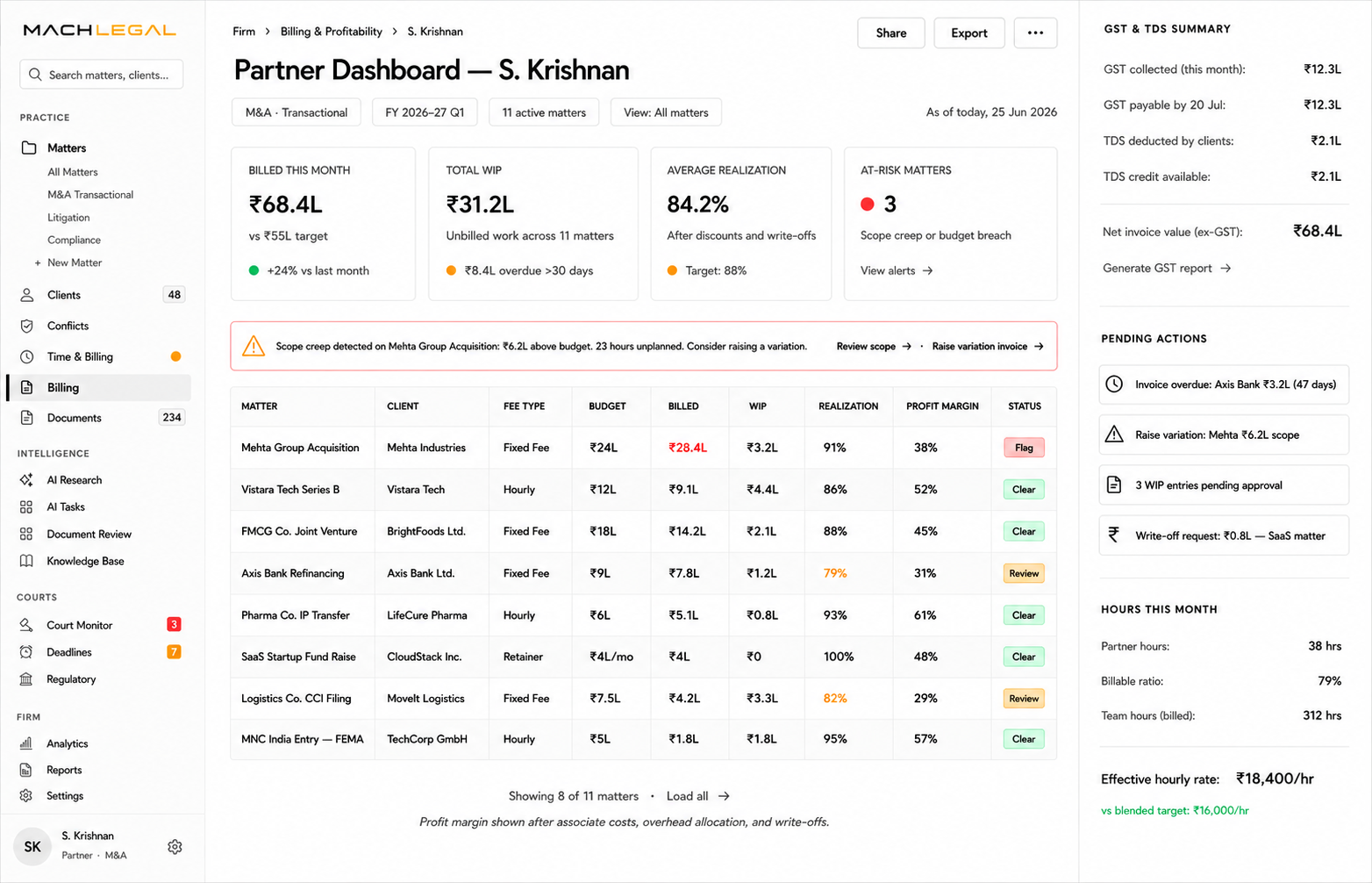
Client management, billing, time, and live profitability — the complete operational backbone, built for how Indian firms actually work.
Client and Group Management
Parent companies and all subsidiaries as one connected entity. Every matter under the group visible in one place.
Conflict of Interest Checks
Mandatory conflict check before every matter opens. Direct, related-party, and prior adverse representation checks.
Matter Intake
Structured intake capturing engagement type, responsible partner, billing arrangement, and the deal facts that feed the engine.
Full Firm Hierarchy
Managing Partner to Articled Clerk. Every role modelled with billing rates, access levels, and capacity tracking.
Time Tracking
Manual and AI-suggested time entries, confirm-before-applying. Time feeds billing and profitability simultaneously.
GST-Correct Invoicing
Full Indian tax compliance on every invoice. TDS handling. UPI and online payment collection.
Live Budget vs Actual
Per-matter and per-workstream budget tracking in real time. Scope creep alerts before write-offs happen.
Per-Matter Profitability
Not at month end. Not at write-off. Now. The feature partners switch software for.
The living matter plan.
The five depth dimensions
Hierarchical Decomposition
A matter nests as deep as the work needs — Matter → Phases → Workstreams → Tasks → Subtasks. Collapse to six phases or drill to a single DD sub-item from the same screen.
Dependency Graph and Critical Path
Every task carries its dependencies. The engine computes the critical path, and when a date moves, every downstream task and the projected close cascade automatically.
Conditional Branching
The plan reshapes to the engagement. Cross-border triggers FEMA and RBI; crossing the CCI threshold adds merger control and gates the close. Same blueprint, different plans.
Decision Gates and Conditions Precedent
Phases stay locked until gate conditions are met. Conditions precedent are first-class objects — owner, status, due date, evidence — and the closing gate opens only when every CP is green.
The Living Plan
The plan never goes stale. As tasks complete and dates shift, the engine continuously re-derives the critical path, the at-risk items, and the projected closing date.
Transactional
M&A · IPO · JV · Fundraising · RefinancingConverges on a closing. Many parallel workstreams. Emphasises the critical path, parallel workstreams, and CP-gated closing.
Statutory
Liquidation · IBC · Scheme · NCLTA mandated legal sequence with prescribed steps and statutory timelines. Emphasises step order and statutory deadline compliance.
Recurring Mandate
Outsourced Legal · Retainers · Panel WorkNo single closing. A container that spawns sub-matters. Emphasises sub-matter intake, SLA tracking, and throughput visibility.
Grounded. Precise. Reviewable.
Research across Indian law.
NyayaAnumana's 700,000+ Indian cases, Indian Kanoon, statutes, and the firm's own past matters — every answer a structured memo, cited to its source. Indian law treated as its own system, not a subset of common law.
Extract what matters from any document.
Upload any document — contract, court order, notification, DD report — and get a structured extraction of obligations, rights, risks, deadlines, and red flags, each cited to the exact clause. Verify any claim in one click.
Review hundreds of documents at once.
Load a bundle, define your questions, and the AI answers every document simultaneously in a grid — rows of documents, columns of questions, a clause-level citation in every cell. Two weeks of associate work in hours.
Better questions. Better outputs.
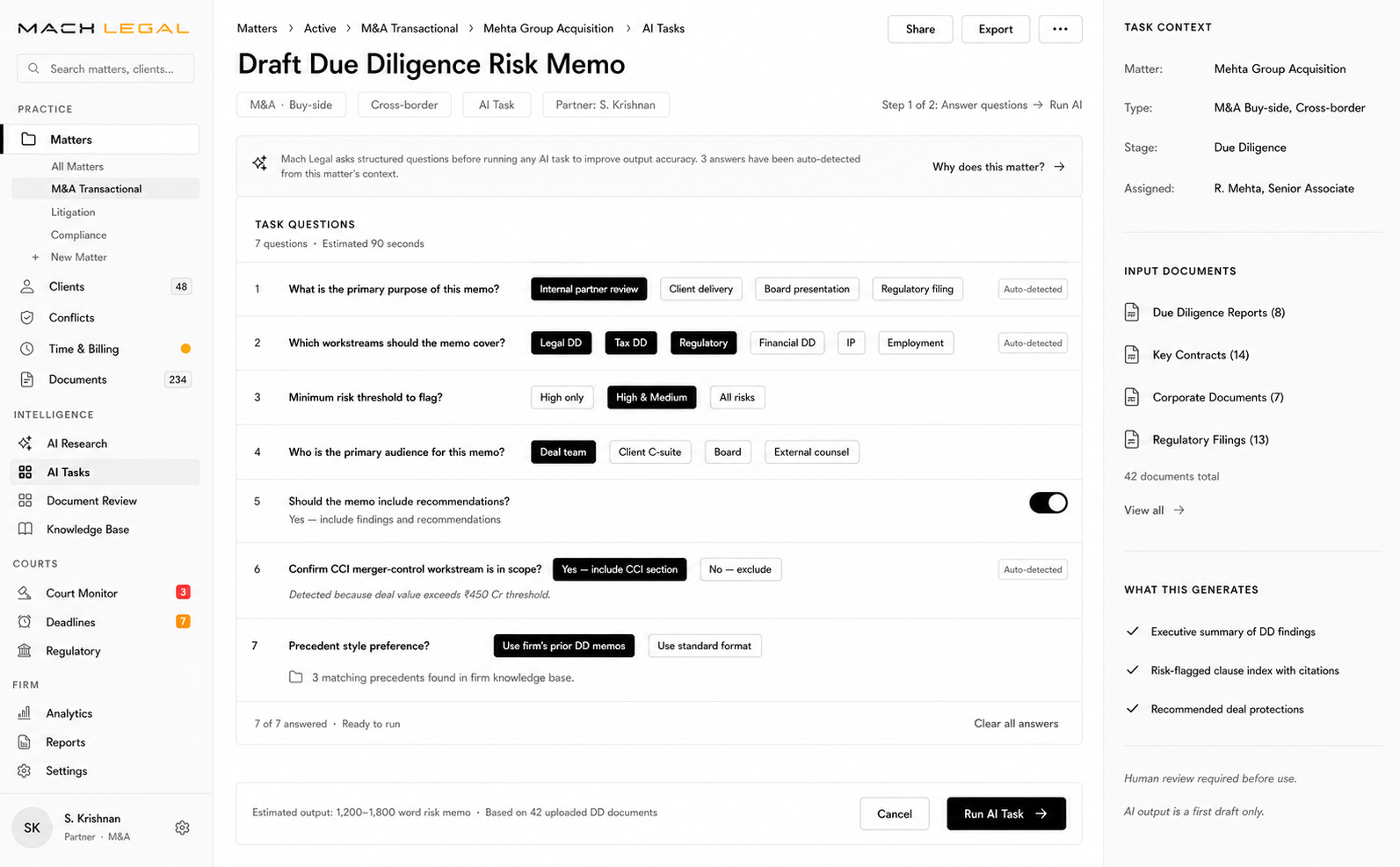
Before any task runs, the system asks five to eight structured questions — purpose, audience, jurisdiction, format. Two minutes from the lawyer, meaningfully better output, no prompt engineering.
Configure once. Share firm-wide.
Build a named workflow once — scope, default answers, output format, firm instructions — and share it across the firm. Guardrails hold regardless: suggest-then-confirm can't be disabled for anything touching money or deadlines.
The AI principle that governs everything.
The engine decides. The AI assists. Every AI output is a suggestion a human confirms before it affects the matter. Nothing touches a deadline, a condition precedent, a gate, or a billing entry without explicit human approval. Turn the AI layer off — the engine still works, the matter still runs, the critical path still recalculates. AI amplifies the platform. It never underpins it.
Live Indian court data. Inside every matter.
eCourts and NJDG Integration
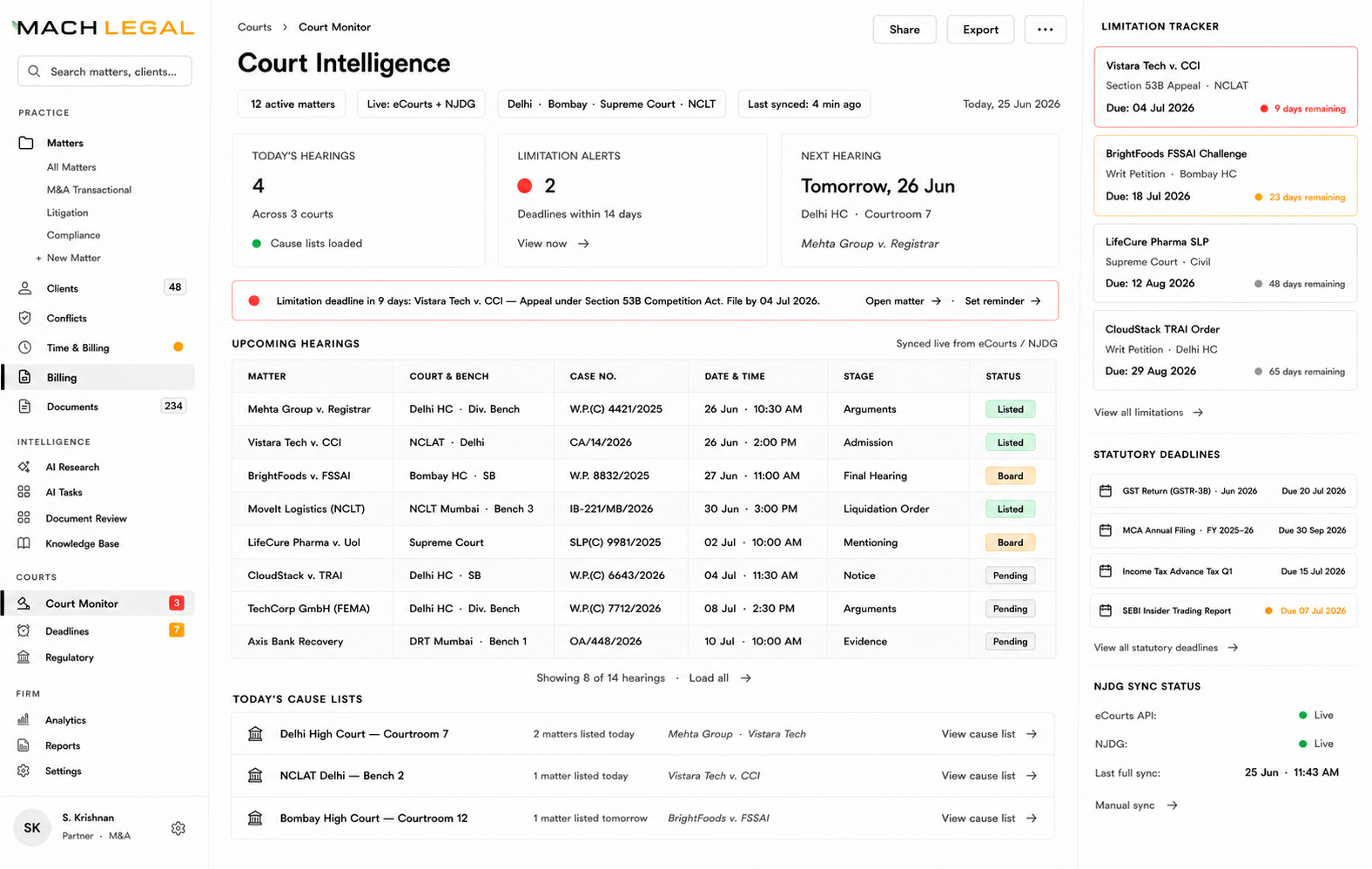
Mach Legal connects directly to eCourts and NJDG, pulling live case status, upcoming hearing dates, cause list entries, and order uploads into the specific matters they belong to. No manual checking. When an order uploads or a hearing is listed, the matter is updated and the responsible lawyers are notified.
Limitation Deadline Monitoring
Limitation periods are computed automatically based on matter type, the relevant statute, and the key triggering events entered into the matter. The system monitors each deadline with configurable multi-stage alerts — 90 days, 30 days, 7 days, 1 day. Missing a limitation is the single most serious malpractice risk in litigation practice. This is the layer that eliminates it.
Statutory Regulatory Calendars
Every matter type carries its own regulatory calendar, populated automatically. MCA and ROC annual filing deadlines for governance matters. Income Tax return and assessment timelines for tax matters. GST return dates. SEBI compliance obligations. Customs timelines. Sector-specific regulatory cycles. All inside the matter, not in a separate calendar system.
Hearing Preparation
The day before a hearing, a lawyer can run the matter through AI to get a current case summary, a chronology of prior orders and arguments, and a structured briefing on what the opposing party's last position was. Grounded entirely in the matter's own documents. Delivered as a structured memo.